Across the western deserts of Turkmenistan lies one of the least visited archaeological sites in Central Asia. Rising from a vast clay plain are two tall brick minarets, the remains of city walls, and the scattered ruins of what was once a major Silk Road settlement. Today the area is known as Dekhistan, though historically its main city was called Mishrian.
For centuries this oasis city thrived as a trading hub linking Persia, Central Asia and the Caspian Sea. Merchants, craftsmen and scholars passed through its gates, and complex irrigation systems turned the desert into fertile farmland. Yet by the fifteenth century the entire settlement had vanished, abandoned to the desert and largely forgotten by the outside world.
Today Dekhistan remains one of the most atmospheric historical sites in Turkmenistan. Its isolation, haunting ruins and deep historical layers make it a remarkable place to explore for anyone interested in Silk Road history and forgotten cities.
The Geography of Dekhistan
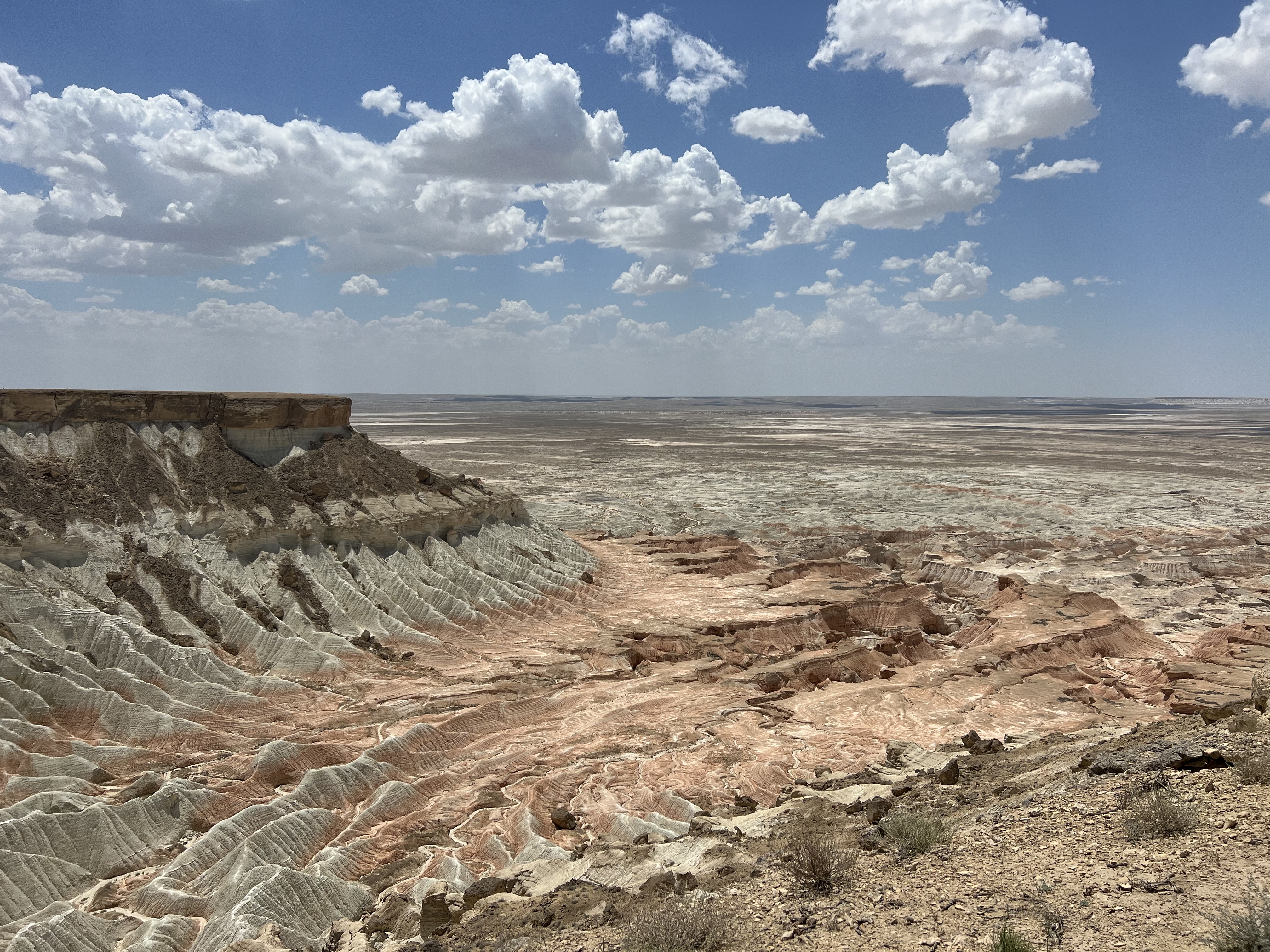
Dekhistan is located in the Balkan region of western Turkmenistan, not far from the Caspian Sea and the modern border with Iran. The landscape is stark and wide open. Flat desert plains stretch to the horizon, broken only by ancient ruins and low archaeological mounds.
In antiquity this landscape looked very different. The region was once part of a fertile oasis fed by irrigation channels and rivers flowing from the Kopet Dag mountains. A key element of this system may have been the Uzboy River, an ancient branch of the Amu Darya that once flowed westward into the Caspian Sea. When this water system began to fail, the entire ecological balance of the region collapsed.
The Mishrian Valley, where Dekhistan is located, would once have been dotted with farms, villages and canals. Today it is largely empty desert, which makes the survival of the ruins even more striking.
Early History of the Oasis
Although the visible ruins mostly date from the medieval period, the history of human settlement in Dekhistan stretches back thousands of years.
Archaeologists believe the oasis was first inhabited during the Bronze Age, roughly around 2000 BC. Early agricultural communities developed here thanks to irrigation and seasonal rivers. Over time these settlements grew and became part of larger regional civilizations.
During the classical period the region likely fell under the influence of the Parthian Empire, which controlled much of present-day Iran and Central Asia. Following the fall of the Parthians in the third century AD, the territory came under the control of the Sasanian Empire. During this era the region remained populated by farmers and small towns while also experiencing the arrival of various nomadic and Turkic groups moving across Central Asia.
These early centuries laid the groundwork for the later rise of a major urban centre.
The Rise of the Medieval City of Mishrian
The true golden age of Dekhistan began during the early Islamic period between the ninth and thirteenth centuries. During this time the city of Mishrian developed into the political and economic heart of the oasis.
At its height the city covered roughly two hundred hectares, making it a significant urban centre by medieval Central Asian standards. Like many cities of the Islamic world, Mishrian had a clear urban structure.
At its centre stood the Shakhristan, the fortified inner city containing the citadel and administrative buildings. Surrounding this was the Rabad, the outer districts where most of the population lived and worked. These districts contained markets, homes, mosques and workshops.
The city was protected by strong defensive walls reinforced with semicircular towers. The presence of such fortifications suggests the city held both economic and strategic importance in the region.
Life in a Silk Road City
Mishrian flourished thanks largely to its position along major trade routes. Caravans traveling between Khorezm, Persia, Bukhara and the Caspian region passed through the oasis, bringing goods and ideas from across the known world.
Archaeological excavations show that the city was a centre for craftsmanship and manufacturing. Workshops produced ceramics, glassware, metal objects and jewellery. Some ceramic fragments discovered at the site even contain inscriptions taken from the Persian epic Shahnameh, demonstrating the cultural connections between Dekhistan and the broader Persian world.
The city also had advanced urban infrastructure. Archaeologists have found evidence of irrigation canals, water supply systems, bathhouses and drainage systems.
The Khwarazmian Period
The peak of Mishrian’s development occurred under the rule of the Khwarazmian dynasty in the twelfth and early thirteenth centuries.
Under their rule the city expanded and new religious structures were built. The most impressive of these were the large mosques and minarets that still dominate the landscape today.
Destruction and Abandonment
The prosperity of Dekhistan did not last forever. By the early thirteenth century the region began to face a combination of environmental and political disasters.
Over centuries the irrigation systems that sustained the oasis had placed increasing strain on the local environment. Gradually water sources declined and the land began to dry out. As canals fell into disrepair, agriculture became more difficult and the population likely began to shrink.
Around the same time Central Asia was struck by one of the most devastating invasions in history. The Mongol armies of Genghis Khan swept through the region in the early thirteenth century, destroying many cities and reshaping the political landscape.
Although Mishrian appears to have survived the initial wave of conquest, the combination of environmental collapse and regional instability weakened the city beyond recovery. By the fifteenth century the settlement had been completely abandoned.
The desert slowly reclaimed the once-thriving oasis, burying buildings beneath layers of sand and clay.
The Surviving Ruins
Today only a small portion of the original city remains visible above ground. The most famous landmarks are the two tall brick minarets rising from the desert.
These twin minarets were originally part of the main cathedral mosque of Mishrian. Although they were built about two hundred years apart, they stand close together and create a dramatic visual landmark visible from miles away.
Another important structure is the Mashad Ata mosque, also known as Shir Kabir. This early Islamic building is considered one of the oldest surviving mosques in Turkmenistan.
Beyond these structures, visitors can still trace the outlines of the city walls and defensive towers. Scattered across the landscape are countless archaeological mounds marking buried buildings and neighbourhoods.
The vast majority of Mishrian remains hidden beneath the desert surface.
Rediscovery by Explorers
For centuries the ruins of Dekhistan were largely unknown outside the region. The first European known to describe the site was British officer and explorer Arthur Conolly in 1830.
Later Russian expeditions documented the ruins in greater detail during the nineteenth century.
Archaeology and Preservation
Excavations throughout the twentieth century uncovered coins, ceramics, porcelain fragments, metal objects and architectural remains. These finds helped researchers reconstruct the history of the oasis and understand its economic importance.
Even today, however, only a small part of the ancient city has been excavated. Much of the settlement remains buried beneath desert soil, meaning future archaeological work could reveal far more about the city’s history.
Visiting Dekhistan Today
Traveling to Dekhistan remains an adventure in itself. The site is extremely remote.
Most visitors reach the ruins from the city of Turkmenbashy on the Caspian Sea or from Balkanabat, the administrative centre of the Balkan region. From there the journey continues by road through empty desert landscapes until the ruins suddenly appear on the horizon.
Because of the remote location and travel restrictions within Turkmenistan, visiting Dekhistan requires joining an organised tour. The journey itself is part of the experience, offering a rare opportunity to see parts of the country that very few travellers reach.
Why Dekhistan Is Worth Visiting
What makes Dekhistan special is not only its history but its atmosphere. Unlike more famous Silk Road cities such as Samarkand or Bukhara, the ruins here stand alone in a silent desert landscape.
There are no crowds, souvenir stalls or large tour groups. Instead, visitors encounter an immense archaeological site where wind and sand move across the remains of a lost civilization.
Standing beside the twin minarets it is easy to imagine the bustling medieval city that once surrounded them. Caravans would have entered through the gates, traders would have crowded the markets, and the call to prayer would have echoed across the oasis.
For travellers interested in the deeper history of Central Asia, Dekhistan offers something unique, an experience very few have had the opportunity to undertake.
To see what Turkmenistan group tours we have, check out our website here. To sign up to one of our Turkmenistan group tours send us an email to [email protected]. If our group tour dates don't work, then ask us about private tours in Turkmenistan.