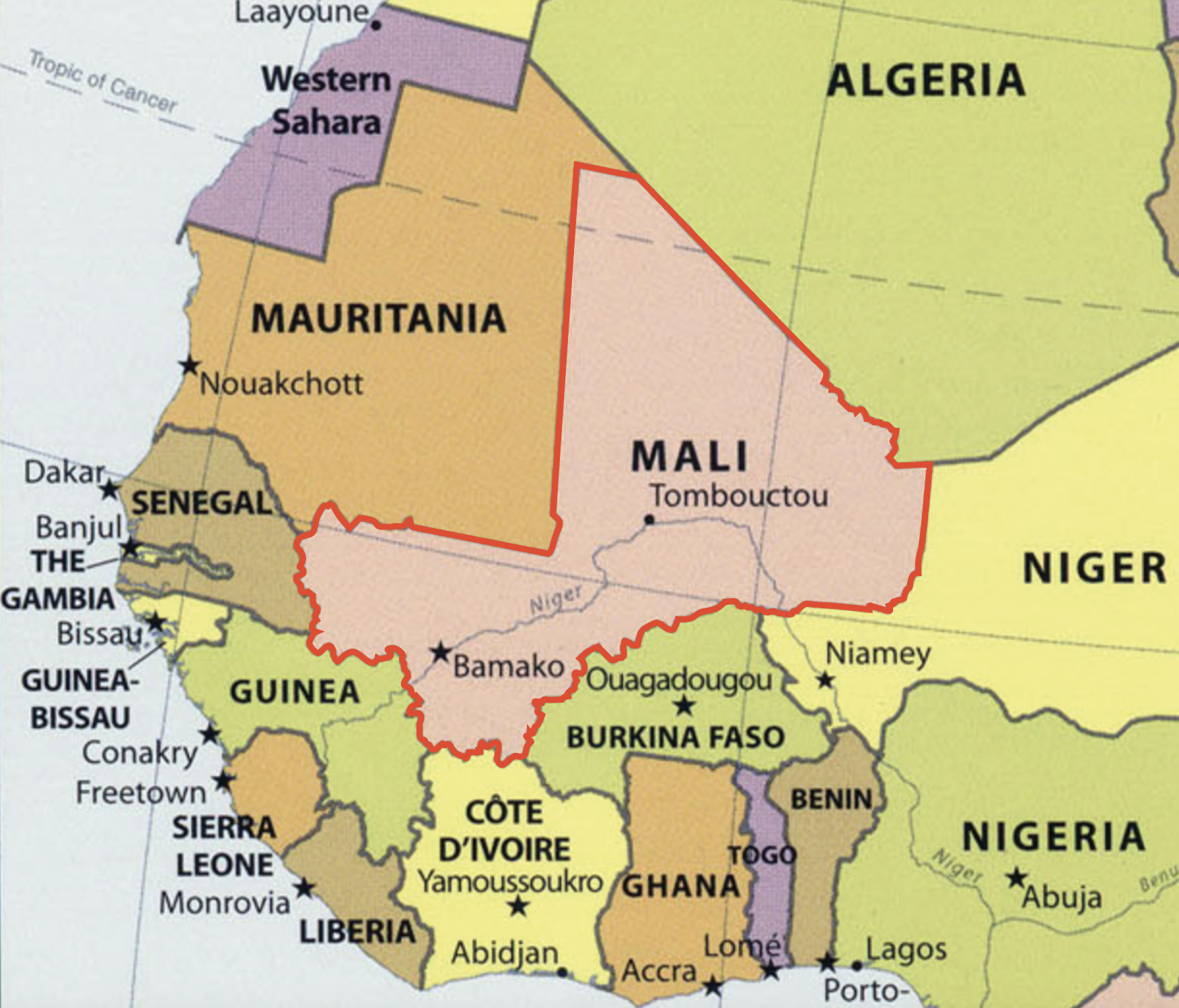

Mali is located in northwestern Africa in the Sahel region. It is bordered by Algeria to the northeast, Mauritania to the northwest, Senegal to the west, Guinea, Ivory Coast, and Burkina Faso to the south, and Niger to the east. Mali’s population is just over 23 million people, and it is an extremely young population. Nearly half of its citizens are estimated to be younger than 15 years old.
Geography of Mali
Mali can be divided into three geographical regions, the Saharan Zone (north), the Sahel Zone (central), and the Sudanic Zone (south). The north of the country is in the Sahara desert and has a hot arid climate. The middle section of the country is in the Sahel, and has semi-arid grasslands. There is some vegetation in these scrublands, but it is a vast steppe with little to no agriculture. The lower region of the country is the most fertile area and the tropical savannah lands here receive the most rainfall. The Niger River flows across the country through this lower zone and the central zone, and has created lakes and floodplains that are essential resources for food production and water.
Regions of Mali

Mali has 19 administrative regions. These are named and numbered. From west to east, the regions are: Kayes, Nioro, Kita, Nara, Koulikoro, Bamako (which is situated inside Koulikoro), Bougouni, Doila, Ségou, Sikasso, Koutiala, San, Mopti, Tombouctou, Taoudénit, Bandiagara, Douentza, Kidal, Gao, and Ménaka. Each of these regions has the same name as the region’s capital (for example Timbuktu is the capital of Tombouctou). Previously, Mali was only separated into 10 regions along with the capital city Bamako. In 2023, the country underwent restructuring into the 19 regions we see today. The aim in breaking the country into smaller regions was to have more localized governance and public services for citizens.
Bamako
Bamako is the largest city and capital of Mali, with a population of around 4 million people. It is the main centre for business, higher education, and government. It is likely where travelers will fly in and out of the country if they are not crossing a land border. Its position on the Niger River made it an important centre for trade throughout its history. There has been much urban development in the past few years, and you can find nice hotels, shopping centres, museums, and public parks here. There is no metro system, but there are public buses. However, the population has expanded past the limits of the public transportation system, so there are many private bus companies as well. Citizens use a mix of both.

Population Density of Mali
The average population density of Mali is about 20 people per square kilometre. The highest population density is in the capital of Bamako, where there is an average of nearly 16,800 people per square kilometre, and the most sparsely populated region of Mali is the Kidal region in the Northeast of the country, with a population density of 0.2 people per square kilometre. Mali’s population is densest in the capital itself, and the surrounding southern regions. The further north you travel, the fewer people there are.