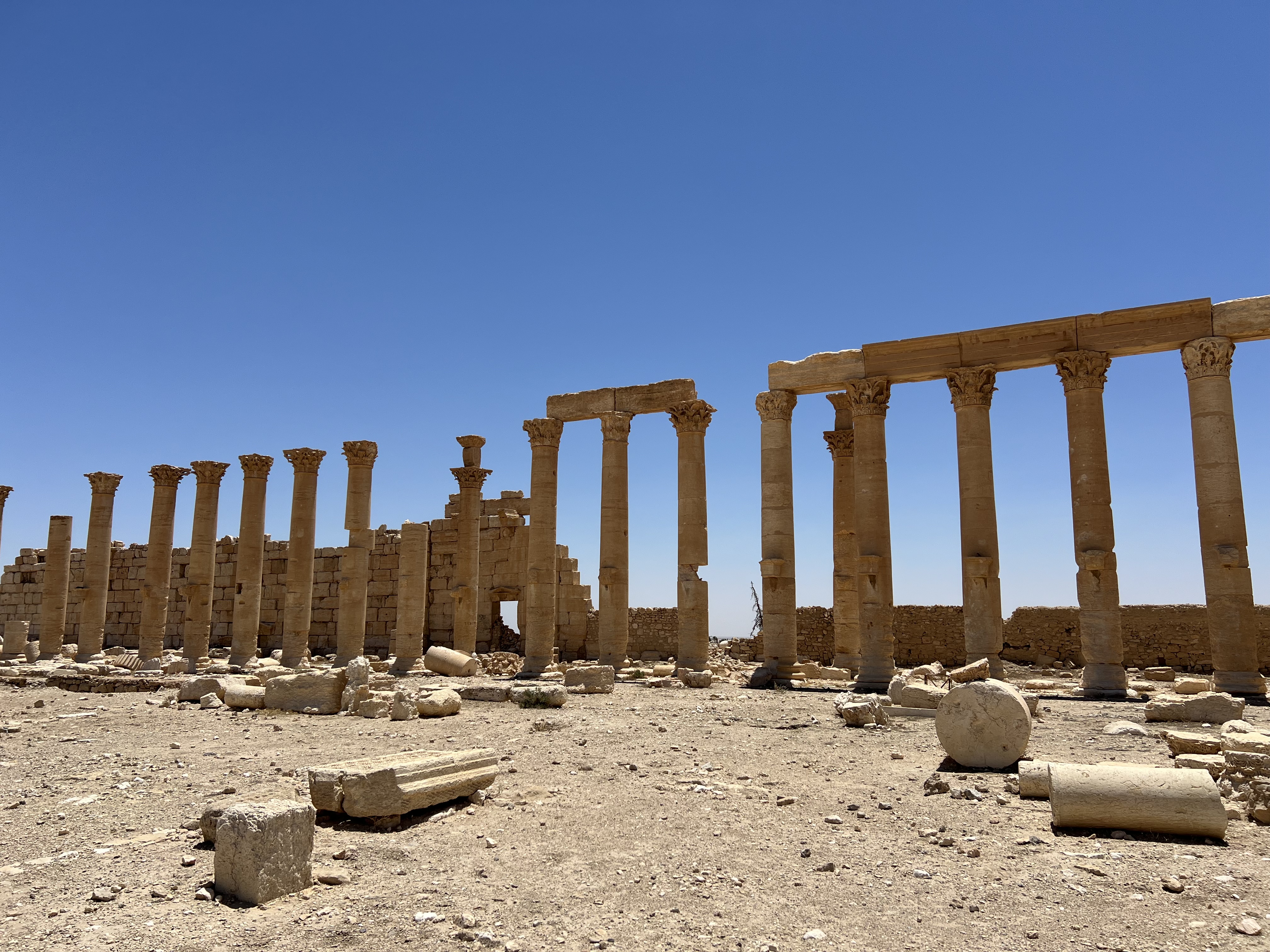
Prior to 2011, Syria was one of the most visited countries in the Middle East, drawing over 8 million tourists a year. It has sites from nearly every era imaginable — Phoenician, Roman, Crusader, Ottoman — amazing food, dramatic scenery running from desert to mountains to the Mediterranean coast, and some of the friendliest, most welcoming people you'll meet anywhere. We've been running tours here since 2017, through the civil war years, the slow reopening under the old government, and now the genuinely new chapter that began when the Assad regime fell in December 2024.
This guide covers everything as things stand today. For the details on specific topics, we've linked out to our dedicated posts throughout — starting with Is Syria Safe for Travel: 2025 Update and our guide to the new Syrian pound .
How to Get a Visa for Syria?
Since the fall of Assad, Syria has run a visa-on-arrival system open to almost every nationality except Iran and Israel. Fees are tiered by nationality — as of our latest information, Jordan, Lebanon, Malaysia and Mauritania pay nothing, most Gulf and Turkish nationals pay around $150, and fees for other nationalities range from roughly $40 up to $300 depending on passport, with the UK, Australia and similar passports around $250 and the US around $300. Land border crossings currently carry no visa fee at all, though that's expected to change eventually.
Because our tours run as government-approved group programmes, you'll need to submit your documents in advance so security clearance can be arranged — this applies to everyone, but US passport holders in particular should apply at least a month before departure given the extra scrutiny. We've broken down the current fee tiers in full in our Syria visa fees guide .
Getting Into Syria — Flights and Land Borders
Air travel to Damascus has changed dramatically. Qatar Airways and Turkish Airlines now fly in from Doha and Istanbul, and Royal Jordanian has returned to the route after a 13-year absence. Local carriers Syrian Air and Cham Wings connect Damascus to Sharjah, Dubai, Abu Dhabi and Cairo, and an Iraqi airline still runs the Damascus–Baghdad route. That said, our own tours still start in Beirut and cross overland to Damascus — Beirut has far better international connections, is cheaper to reach, and frankly we love the city. If you'd rather not backtrack to Beirut at the end of your trip, you now have the option of flying onward directly from Damascus instead.
The most common land crossing is the Beirut–Damascus highway from Lebanon; crossings further north near Tripoli exist but are used mostly by freight, since wait times are longer there. Crossing into Jordan is possible but stricter, with longer waits than the Lebanese route. It's also possible to cross into Turkey via the small town of Kasab, north of Latakia, though this requires security clearance from the Turkish side. Crossing into other parts of Turkey near Aleppo, or into Iraq, still isn't possible for foreign travellers.
Staying connected is easier than most people expect, too — Syria has two main mobile providers, MTN and Syriatel, both with reasonable coverage in the cities and along the main tourist routes, so picking up a local SIM isn't the ordeal some travellers assume it will be based on the country's recent history.
Money — Currency and Costs
The Syrian pound went through a complete overhaul at the start of 2026 — new, portrait-free banknotes and a redenomination that removed two zeros from the currency. We've covered the full story, including what the notes look like and the current exchange rate, in our guide to the new Syrian pound and our original currency reform announcement . In short: bring US Dollars in cash. Restrictions on using foreign currency openly have eased significantly since the political transition, and USD is now the most useful currency to carry. ATMs exist but are tied to the Syrian banking system and dispense pounds only — foreign cards don't work here due to sanctions, so don't plan around having card backup.
Health
There are no mandatory vaccinations for entry, but routine vaccinations should be up to date, and it's worth discussing hepatitis A and typhoid with a travel clinic given variable food and water standards outside main hotels. Stick to bottled or filtered water throughout your trip rather than tap water. Medical facilities in Damascus are reasonable for straightforward issues, but comprehensive travel insurance with medical evacuation cover is essential — options elsewhere in the country are far more limited, and this is not a country to be under-insured in.
Is Syria Safe to Travel?
This is the question we get asked more than any other, and we'd rather answer it properly than gloss over it — read our full Is Syria Safe for Travel: 2025 Update for the complete picture. The short version: our people on the ground describe the current environment as safer for tourists than it has been in years. Under the old government you had to watch what you said about the Assad family in public — that pressure is simply gone now, and the general mood is markedly more relaxed. We've run tours through the civil war years, the slow Assad-era reopening, and now this new chapter, and in that entire time our only real incident has been food poisoning.
One tangible sign of how much has changed: Idlib, off-limits for over a decade as former rebel-held territory, is now accessible. We've written a full explainer in Is It Safe to Travel to Idlib? if you want the background. As with any of our higher-risk destinations, we keep our itineraries under continuous review and adjust with local guidance — this is a rapidly improving situation, not a static one, so always check with us for the latest before you book.
Food
Syrian food is one of the best reasons to visit on its own — it's Levantine cuisine at its best, and one of the more vegetarian-friendly food cultures in the Middle East, since meat isn't the centrepiece of every meal the way it is elsewhere in the region. We've written a full piece on this angle in Being a Vegetarian in Syria , but it's worth reading even if you're not vegetarian, since it doubles as a great primer on Syrian food generally.
Meals are a serious, drawn-out event — expect a spread of dips and salads first, with mains arriving well after you're already full, so pace yourself if you're eating with locals, because they will absolutely over-order. Damascus and Aleppo both have standout food scenes, with Aleppo's large Armenian population giving it a particular claim to being the country's culinary capital.
Five dishes worth seeking out on any trip:
- Hummus — the chickpea dip everyone already knows, but Syrian hummus, made fresh and often served warm with a pool of olive oil, is a different experience to the tubbed version you'll have had at home.
- Manaqesh — a thin, flatbread-style street food snack, most commonly topped with za'atar, a mixture of herbs, sesame and sumac. It's sold everywhere and makes a perfect breakfast or quick bite between sites.
- Kibbeh — a Levantine classic of minced meat mixed with bulgur wheat and spices, usually shaped into torpedo-like shells and fried, though baked and raw versions exist too. Considered by many Syrians to be the national dish.
- Baba ganoush — a smoky dip made from grilled eggplant, usually served alongside hommos as part of a wider mezze spread at the start of a meal.
- Falafel — a genuine everyday staple here rather than a novelty vegetarian option, sold from street stands across the country for next to nothing and every bit as good as its reputation elsewhere in the region suggests.
We could list foods in Syria endlessly and it is definitely a highlight to any tour of Syria. The best way to experience one of the world’s best food countries.
What Are the Main Sites to See in Syria?
Damascus is the natural starting point for almost every trip, and one of the best cities in the Middle East to spend time in. The Hamidiyeh Souq and the Umayyad Mosque are unmissable, along with the old town, the North Korean-built October War Museum, the Damascus Opera and the Handicrafts Market. It's also just a genuinely vibrant, exciting city to wander — plan to linger rather than rush through.
Palmyra is the country's premier ancient site, a huge ruined desert city that was badly damaged by ISIS — including the main Temple of Baal — but remains hugely impressive despite the losses, with restoration work slowly ongoing. Aleppo, Damascus's more conservative cousin, has its own remarkable souq and citadel, striking stone architecture, and that Armenian-influenced food scene. Latakia, on the coast, is the chill, party-friendly side of Syria — untouched by the war, popular with locals, and home to seaside restaurants, bars and swimming spots.
Krak des Chevaliers, the best-preserved of Syria's Crusader castles, has sweeping valley views and hosts festivals — including the occasional techno party — every August. Bosra, in the far south, holds the world's largest black basalt Roman amphitheatre, once used for events with a capacity of 20,000. And Maaloula, in the hills north of Damascus, is one of the last Aramaic-speaking villages left in the world, with a beautiful monastery and the ruins of a hotel destroyed during the war.
What to See and Do in Syria and our New Places to Visit in Syria are both worth reading for more detail on specific sites as access continues to open up.
Languages
Arabic is the official language, spoken by the vast majority of the population. Kurdish is widely spoken in the northeast, and smaller communities of Circassians, Armenians, Turkmens and Assyrians add to the country's linguistic and ethnic mix. English is reasonably common among guides and in the tourism industry, though a few Arabic phrases go a long way with locals.
Culture and Customs
Dress in Syria is more relaxed than many visitors expect — shorts and t-shirts are fine in Damascus and Latakia, though you may feel more comfortable dressing slightly more conservatively in Aleppo and Hama, simply because locals there tend to as well. Photography is generally allowed and even encouraged, with one firm exception: never photograph anything military, Syrian or foreign, including checkpoints or convoys — doing so can cause serious delays for your whole group.
Conversation with your guides is open and easy, but some topics — the war, the Assad family, ISIS, Israel — are best kept for private settings rather than discussed loudly in public. Many Syrians prefer to call the past decade-plus "the crisis" rather than a civil war, given the range of actors involved, and it's worth being sensitive to the fact that people you meet lived through it directly. Religiously, Syria is majority Sunni Muslim, with significant Shia, Alawite and Christian communities — Christians are estimated at around 20% of the population, though precise figures are hard to come by after years of conflict and displacement.
If your visit lines up with it, the Marmarita Festival , held every August in the Valley of the Christians, is a genuinely colourful, only-in-Syria experience worth building a trip around.
What to Pack for Syria
Pack for hot, dry summers and mild winters — light, breathable clothing for most of the year, with something warmer for winter evenings, particularly if you're visiting mountain areas like Maaloula. A universal adapter (Syria uses the European two-pin plug, type C), comfortable walking shoes for souks and ancient sites, and sun protection for desert stops like Palmyra are all worth having. Bring US Dollars in cash rather than relying on cards, and a mix of denominations makes markets and tipping easier. Modest clothing is worth packing for Aleppo and Hama, even though it isn't strictly required.
When Is the Best Time to Visit Syria?
July in particular gets brutally hot, especially out at Palmyra in the middle of the desert, so it's best avoided if you can help it. April, May, August, September and October are all good windows, with more comfortable temperatures across the country. If you can time a trip around the Marmarita Festival in August, it's a great reason to pick that month specifically.
Syria isn't the same country it was even two years ago, and we don't think it will stay the same as it is today for very long either — this is a place changing fast, in a good way. For travellers willing to go in with an open mind, it remains one of the most rewarding destinations we run tours to anywhere in the world.
Do we offer Syria tours?
Yes — we've been running tours to Syria since 2017. Take a look at our Syria tours for what's currently running, including our regular departures and one-off tours built around events like the anniversary of the fall of Assad and the Marmarita Festival.
How can I book a tour?
Send us an email at [email protected] and we'll help you plan your trip.