We first wrote about Syria’s new currency the day it was announced, back in December 2025. That was the announcement stage — a redesigned, redenominated Syrian pound with no Assad-family portraits on it for the first time in the currency’s history. Enough time has now passed that we can answer the two questions people actually ask us before a trip: are the new notes really the ones you’ll be handed at the border, and what’s the exchange rate today?
Are the new banknotes actually in circulation now?
Yes. The new pound entered circulation on January 1, 2026, and old and new notes coexisted for a 90-day transition window while the Central Bank of Syria phased the old Assad-era notes out through banks and designated exchange centres. That window closed around the start of April 2026, so by the time you read this, the notes you’ll actually be handed in Damascus, Aleppo or anywhere else are the new design — not the old ones.
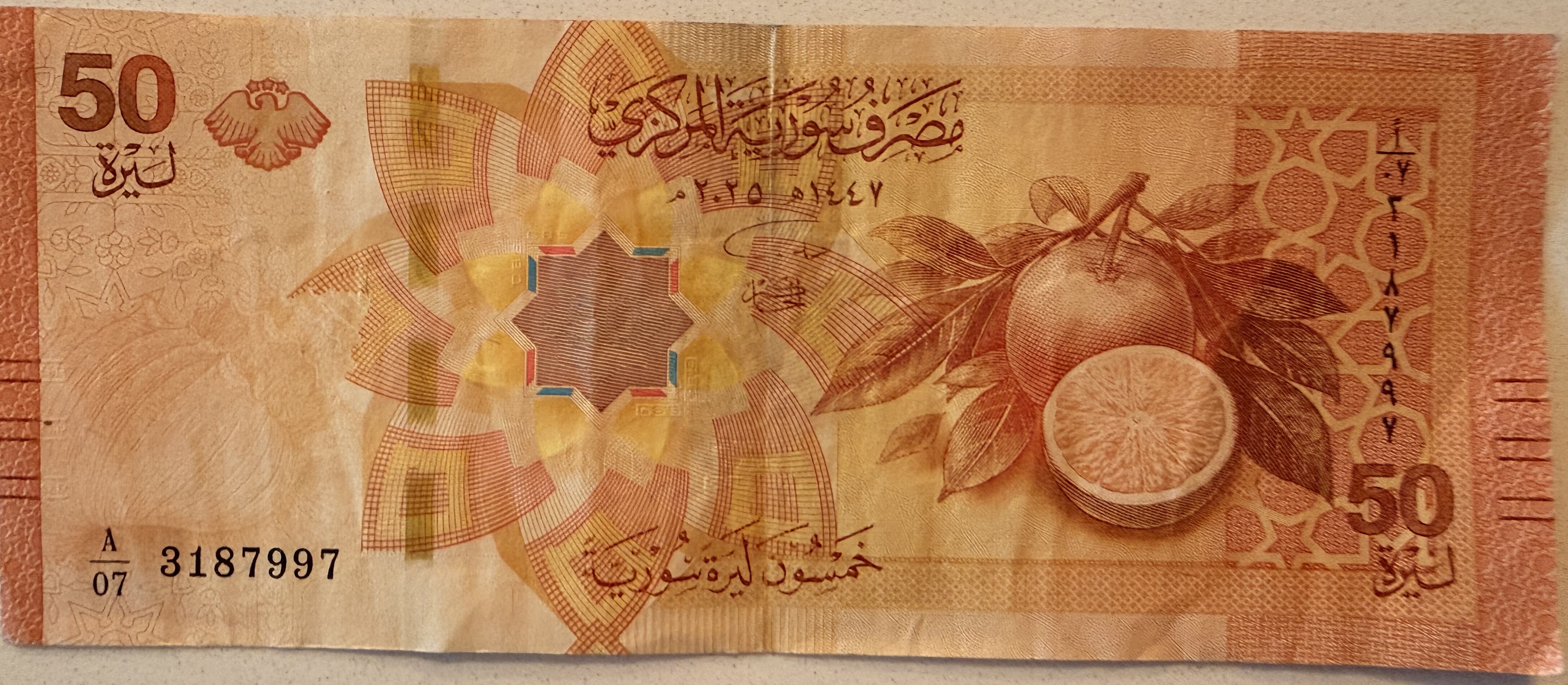
The new notes come in denominations of 10, 25, 50, 100, 200 and 500 Syrian pounds, and every single one features a natural or agricultural motif rather than a person — the Damask rose, mulberry, orange and coastal scenes, cotton and gazelle, olive tree and horse, and birds over wheat fields, depending on the denomination. President Ahmad al-Sharaa described the approach as "no faces, no places," pitched as a deliberate break from the personality-cult currency design of the Assad decades.
We were also in Syria in April during the transition phase when both sets of notes (old and new) were in circulation. Boy oh boy was this confusing. But since May you can only use the newly issued notes with the new denominations.
What's the exchange rate today?
As of July 2026, the new Syrian pound is trading at roughly 122 SYP to 1 US Dollar, and around 139 SYP to 1 Euro. If you're used to the old figures, remember the redenomination removed two zeros — 122 new SYP is the equivalent of about 12,200 old SYP, which puts it in a similar ballpark to where the pound was sitting on the black market just before the redenomination, rather than representing some dramatic overnight change in what your money is actually worth.
The rate isn't perfectly settled yet — it's weakened by a few percent over the past month alone, and Syria still runs with both an official rate and a black-market rate that don't always match, a legacy of the currency controls under the old regime that the new Central Bank is still working through. If you want live numbers before you travel rather than relying on a blog post, apps like LiraToday track the day-to-day rate. For the bigger picture on how we got here, our original currency reform post and our Syrian Pound Today piece cover the hyperinflation years in more depth. The current difference between thew black market rate and the official rate is not huge and is set to be normalized in the future.
Can I still use US dollars in Syria?
Yes, and it's genuinely the easiest way to travel. Since the political transition, restrictions on foreign currency have eased considerably — under the old regime, using USD openly was technically restricted and came with real legal risk; today it's widely accepted, particularly for anything above small day-to-day purchases. We'd still recommend carrying newer, undamaged USD notes, since exchange points can be picky about condition and older pre-2006 designs.
ATMs exist in Syria, but they're tied to the local banking system and dispense Syrian pounds only — foreign bank cards don't work due to ongoing sanctions, so this isn't a country where you can rely on your card as a backup. Bring the cash you need for the whole trip.
Euros and Turkish Lira are also fine to use throughout the country, especially if you are in the area of Idlib where many things are priced in Turkish Lira over Syrian pounds.
What does this mean if you're planning a trip?
- Bring US Dollars in cash — this is still the most useful and widely accepted currency, and gets the best rates.
- Bring a mix of denominations. Small notes make markets, tips and taxis far easier than trying to break a large bill.
- Don't rely on cards or ATMs for foreign currency. Whatever you bring in cash is what you'll have.
- If you've got old Syrian pound notes left over from a previous trip, they're no longer in circulation — don't expect to spend them, and don't bother trying to exchange small amounts.
We'll keep updating this as the exchange rate and rollout continue to settle. In the meantime, our guide to Syrian land border crossings and Is Syria Safe for Travel: 2025 Update are both worth a read if you're planning a first trip.
Do we offer Syria tours?
Yes — we've been running tours to Syria since 2016 and have watched the country go through several distinct chapters since. Take a look at our Syria tours for what's currently running.
How can I book a tour?
Send us an email at [email protected] and we'll help you plan your trip.