Togo is one of those countries that barely registers on most people's West Africa shortlist, and we genuinely don't understand why. At just under 57,000 square kilometres and roughly 8.6 million people, it's one of the smallest and most compact countries on the continent — you can drive from the coast to the northern border in a single day. But it packs in voodoo markets, mountain coffee towns, a genuinely stunning UNESCO site, and some of the friendliest, most laid-back cities in the region. This guide pulls together everything we've learned from running trips here.
For more detail on specific parts of the trip, see our guides on getting a Togo e-Visa , crossing Togo's land borders , and visiting the Akodessewa Voodoo Market in Lomé.
How to Get a Visa for Togo?
Togo runs almost all of its entry formalities through a single government platform, Togo Voyage (voyage.gouv.tg), and most non-ECOWAS nationalities need to apply for an e-Visa before arrival. Citizens of ECOWAS member states — Benin, Burkina Faso, Cape Verde, Côte d'Ivoire, The Gambia, Ghana, Guinea, Guinea-Bissau, Liberia, Mali, Niger, Nigeria, Senegal and Sierra Leone — don't need a visa at all. Passport holders from the US, UK, EU, Australia and Canada do.
Even if you're visa-exempt, you still have to register your trip on the Togo Voyage platform and print the confirmation slip — known as the attestation d'inscription — before you fly. Airlines check for it at check-in, and you won't be allowed to board without it. For a standard tourist visa, you'll need a completed online application, a scan of the first three passport pages, a passport photo, and proof of your flight booking. Cost depends on length of stay and entry type: 25,000 CFA (roughly $40 USD) for 1-15 days single entry, up to 65,000 CFA for a 31-90 day multiple-entry visa. Standard processing takes up to 5 business days, and the government recommends applying at least 6 business days ahead — there's an express option for late applications, but we wouldn't rely on it. Our full Togo e-Visa guide covers every step in detail, including payment methods and what to do if you're short on time.
Getting Into Togo — Flights and Land Borders
Most travellers fly into Lomé–Tokoin International Airport, which has decent connections across West Africa and a handful of European routes. If you're coming overland, Togo borders Ghana, Benin and Burkina Faso, and the crossing you use depends on your route.
The busiest crossing by far is Aflao–Kodjoviakopé on the Ghana side, right on the coastal route between Accra and Lomé — a short walk of well under a kilometre between the two immigration posts, operating roughly 6am to 6pm. From Benin, almost everyone uses Hillacondji–Sanvee-Condji, a joint control facility about 97km from Cotonou and 21km from Lomé, where Beninese and Togolese officials process you at the same point. The crossing from Burkina Faso, at Cinkassé on the Ouagadougou-Lomé corridor, is technically an upgraded Integrated Border Post, but given the current security situation in Burkina Faso, we're not currently recommending independent overland travel across it. Our full guide to Togo's land borders covers all three crossings in detail, including a note on a common money-changer scam at Aflao worth knowing about before you go.
Money — Currency and Costs
The currency is the West African CFA Franc (XOF), shared with seven other West African countries and pegged directly to the Euro at a fixed rate, so it doesn’t fluctuate the way some currencies in the region do. Togo is genuinely good value — budget travellers can get by on somewhere between $20-60 a day covering basic accommodation, street food and local transport, and even a comfortable mid-range trip with a proper hotel and restaurant meals rarely tips past $100 a day. Major hotels in Lomé take cards, but you’ll want cash for markets, taxis, tipping guides and anywhere outside the capital, so carry Euros or US Dollars to exchange, or use a local ATM to top up — ATMs are reasonably reliable in Lomé but scarce once you head inland toward Kpalimé or Koutammakou, so stock up in the capital before you head out.
Health
Yellow fever vaccination is mandatory for entry into Togo, not just recommended, and you’ll need to show your certificate on arrival regardless of where you’re flying in from — pack it with your passport, not buried in checked luggage. Malaria risk is present year-round across the whole country, so prophylaxis is worth discussing with a travel clinic before you go, and routine vaccinations (hepatitis A/B, typhoid, tetanus) are all sensible additions. Tap water isn’t safe to drink — stick to bottled or filtered water throughout the trip, including for brushing your teeth if you want to be cautious. Healthcare in Lomé is reasonable for a regional capital, with a handful of private clinics used to treating travellers, but anything serious is best evacuated to Accra or outside of Togo.
Is Togo Safe to Travel?
Togo is one of the more stable countries in a region that's had a rough few years — it doesn't carry the same level of advisory as Burkina Faso, Mali or Niger next door, and Lomé in particular is a genuinely relaxed, walkable capital. As with anywhere, normal precautions apply: keep an eye on your belongings in busy markets, avoid flashing valuables, and use registered taxis at night. The main area we'd flag some caution around is the far north near the Burkina Faso border, where the wider Sahel security situation has occasionally spilled over — we don't currently run itineraries up there, and would recommend checking the latest government advisories if you're planning to go independently.
Food
Togolese food shares a lot of DNA with the rest of coastal West Africa — think rich, spiced stews built around tomato, onion and chilli, served over rice, fufu or pâte (a smooth cornmeal staple similar to Ghanaian banku). Fresh grilled fish is everywhere along the coast, and street food in Lomé is excellent and cheap — grilled corn, akara (bean fritters) and brochettes are all worth hunting down. A meal at an inexpensive local restaurant typically runs a couple of dollars, and even a proper sit-down dinner for two rarely tips past $30-35, making Togo one of the better-value food scenes in West Africa. We've written a full guide to eating well in Lomé on a budget if you want specific recommendations rather than just the general picture.
What Are the Main Sites to See in Togo?
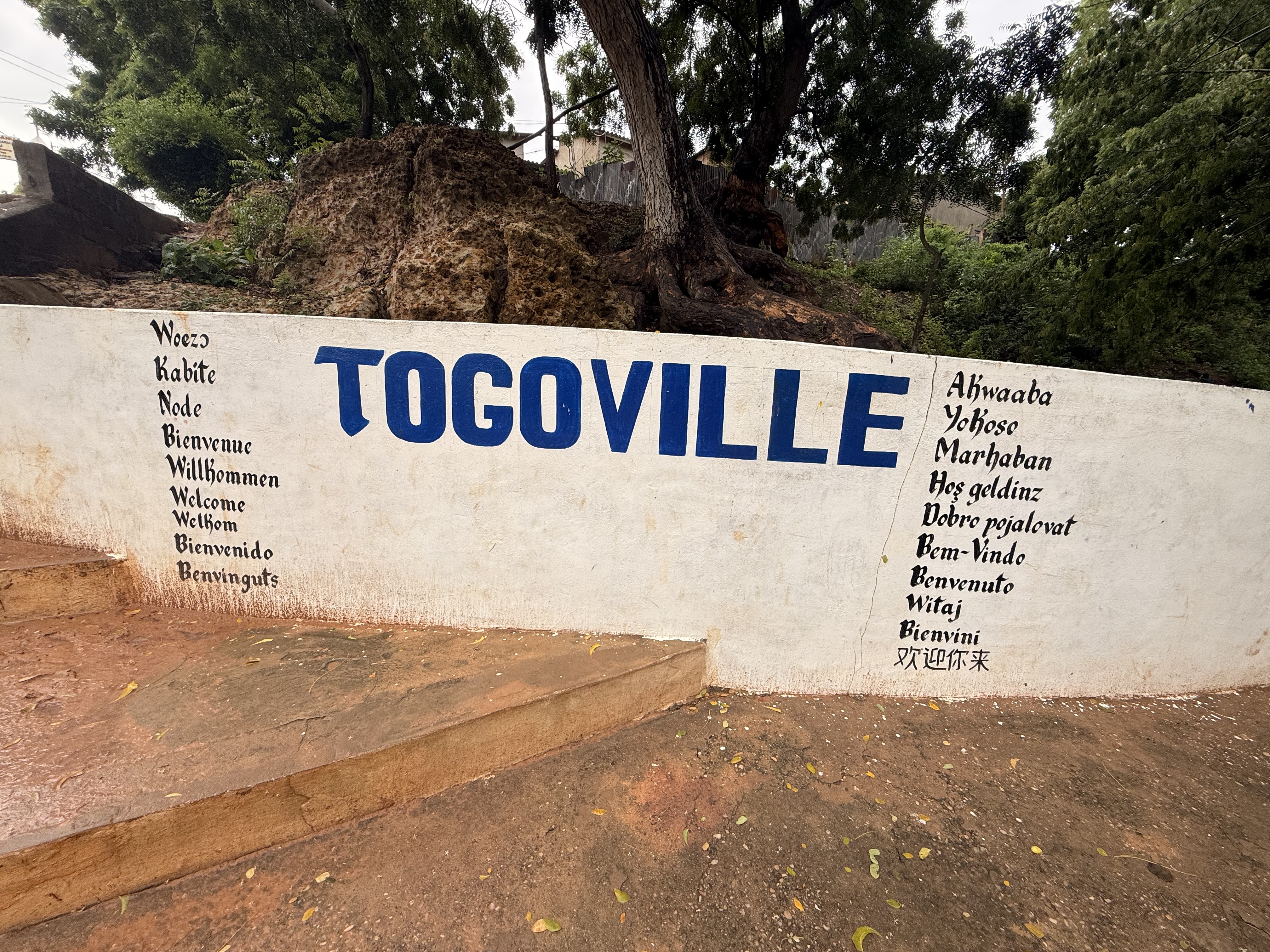
Lomé itself is worth a couple of days. The Grand Marché is one of the great chaotic markets of West Africa, and the Akodessewa Voodoo Market is genuinely one of the most unusual, memorable sights you'll see anywhere on the continent — stalls lined with animal skulls, skins and talismans used in traditional Vodun healing and ritual, still very much a working religious market rather than a tourist recreation. Just outside the city, Lake Togo is a calm, scenic lagoon good for boat trips out to fishing villages and the town of Togoville, the historic seat of Togolese voodoo tradition and where the Feto Kata festival draws practitioners from across the region every year.
Head inland to Kpalimé and the landscape changes completely — lush, green, mountainous, and covered in coffee and cocoa plantations. It's the base for hiking Mount Agou, Togo's highest peak at just over 986 metres, and for visiting waterfalls like Kpimé and Womé. The town itself has a strong tradition of butterfly collecting and woodcarving, and the surrounding villages are some of the most scenic in the country.
Further north, Koutammakou is Togo's standout site and a UNESCO World Heritage Site — the Batammariba people's extraordinary turreted mud-tower houses, known as Takienta, look like something out of another century, because in many ways they are. Each Takienta functions as a self-contained home, with granaries, sleeping quarters and even small altars built into its distinctive round towers, and the wider Koutammakou landscape is still very much a living, inhabited site rather than a preserved ruin — families continue to build and maintain Takienta in the same style today.
Languages
French is Togo’s official language, a legacy of colonial rule, and it’s what you’ll need for anything official or formal. Ewe is the dominant local language in the south, including Lomé, while Kabiye is more widely spoken in the north, alongside more than 35 other local languages spoken across the country. English isn’t widely spoken outside hotels and tour operators, so a handful of French phrases will take you a long way.
Culture and Customs
Togo is one of the spiritual heartlands of Vodun (voodoo), and it isn’t confined to the Akodessewa market — traditional religion coexists openly alongside Christianity and Islam across the country, and many Togolese who identify with either will still take part in Vodun ceremonies and consult traditional healers. Ancestor veneration, animist belief and Christian or Islamic practice sit side by side rather than in competition, and visiting a fetish market or a voodoo festival is treated as a normal part of local life rather than a performance for tourists. If you’re invited to observe a ceremony, dress modestly, ask before taking photos, and follow your guide’s lead on what’s appropriate to approach.
What to Pack for Togo
Pack light, breathable clothing — Togo is hot and humid for most of the year, especially along the coast, with humidity in Lomé regularly sitting above 80%. Bring a light rain jacket if you’re travelling during the wet season, comfortable closed shoes for Koutammakou and Kpalimé’s waterfall trails, and modest clothing for visiting markets and voodoo sites, where covering shoulders and knees is appreciated. A universal adapter (Togo uses the European two-pin plug, 220V), a reusable water bottle, a dry bag for the boat trip on Lake Togo, and mosquito repellent with a decent DEET concentration are all worth having. Cash in small denominations is more useful than you’d expect — markets and rural areas rarely have change for larger notes.
When Is the Best Time to Visit Togo?
November to March is the sweet spot — the dry season brings sunnier days, lower humidity and more comfortable travel across the country, and it’s the best window for hiking around Kpalimé and visiting Koutammakou, where muddy roads during the wet season can make the drive north considerably slower. The wet season runs roughly April to October, with a short lull around August, and while it doesn’t make travel impossible, roads inland can get muddier and some hikes less appealing. Temperatures in Lomé stay fairly consistent year-round, in the high 20s to low 30s Celsius, so it’s humidity and rainfall rather than heat that really drives the choice of when to go.
Togo is a small country that rewards curiosity — it doesn’t have the big-name landmarks of some of its neighbours, but that’s part of the appeal. Between the voodoo markets of Lomé, the mountains around Kpalimé and the extraordinary architecture of Koutammakou, it’s one of the most underrated countries in West Africa.
Do we offer Togo tours?
Not as a standalone tour at the moment, but Togo sits right alongside several of our other West African trips. Take a look at our Africa tours for what’s currently running across the region.
How can I book a tour?
Get in touch with us at [email protected] and we’ll help you plan your trip to Togo.