There are no boring destinations, just boring people.
Brunei is the proof. It's a tiny, oil-rich sultanate on the island of Borneo that most travellers write off before they land. The usual story goes like this: fly in, see the capital's mosques, wander around Bandar Seri Begawan for a day, tick it off, then tell everyone how dull it was. That's not Brunei being boring but rather an inexperienced traveller expecting the excitement to come to them.
Get out of the capital and Brunei turns out to be a country with an oil town where pumpjacks work beside school grounds, what's widely called the largest stilt settlement on Earth, a museum that takes gold-plating to a whole new level, an abandoned coal mine, a once-free amusement park that has gone quiet, a 30 km bridge across a bay, and some of the cheapest and best street food in Southeast Asia. Here's how to see it properly.
Seria, the oil town that mixes business and pleasure
 Seria is where Brunei's wealth came from, and it doesn't hide it. Oil was first struck here in 1929, and the town still sits at the centre of the country's oil and gas industry.
What makes it weird is how normal everything feels around it. Nodding-donkey pumpjacks, which locals simply call donkeys, tick away beside houses, schools and shops. Drive the coast road between Kuala Belait and Seria and you'll pass them constantly, like street furniture.
The headline act is the Billionth Barrel Monument, down by the beach. It was unveiled on 18 July 1991 to mark one billion barrels of crude from the onshore Seria field, and it stands close to the S-1 well, the first one drilled here. Walk the approach and you'll pass copper panels telling the story of Brunei's oil and gas industry, then pumpjacks, drilling gear and an old train locomotive around the monument itself. There are also panels singing the praises of the oil company Shell.
Next door is Panaga, the residential base for Brunei Shell Petroleum. It's a world of its own, with company housing, expat clubs, an 18-hole golf course and an equestrian area. Seria is roughly 100 km from the capital, and the Kuala Belait Museum a short drive west is worth a look for more on the oil story.
Kampong Ayer and life on stilts
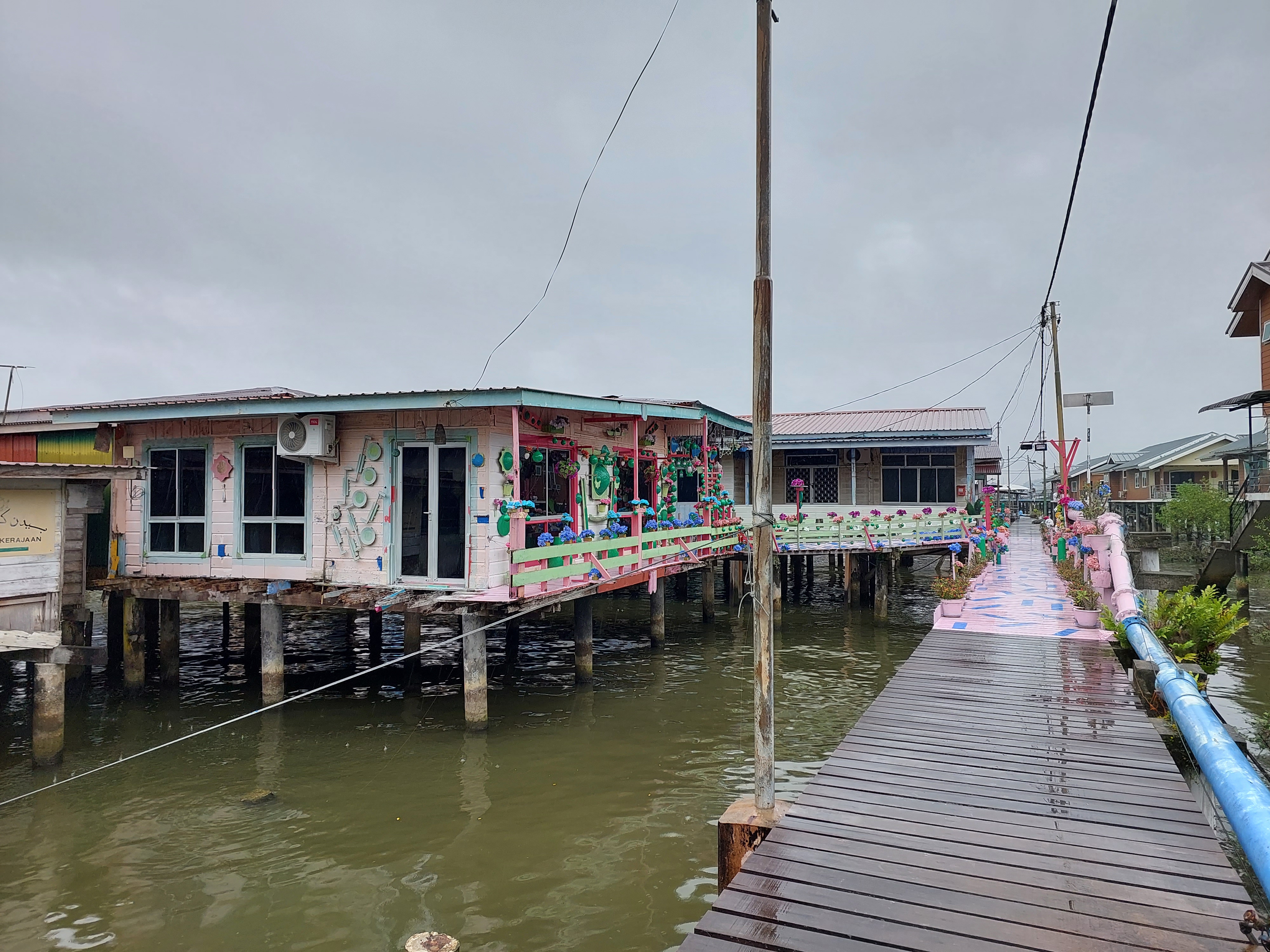
 Kampong Ayer, literally the "water village", is a cluster of around 42 stilt villages strung along the Brunei River, right beside the capital's skyline. It's widely described as the largest stilt settlement in the world, and it has been around for a very long time: the Italian explorer Antonio Pigafetta wrote about a city built over the water here in 1521. A century ago, roughly half of Brunei's Malay population lived on the river. Estimates of today's population vary a lot, from about 10,000 to as many as 30,000.
The thing that surprises people is how modern it is. The houses are linked by boardwalks and bridges, and the villages have schools and mosques on stilts too. Homes have electricity, running water, satellite TV and, in many cases, air-conditioning. Since around 2013 the government has been building new two-storey concrete stilt homes, each with its own boat jetty, so old wooden houses and shiny new ones now sit side by side.
Water taxis run between the jetties and the riverbank and cost only a dollar or two (check the current fare). Hop on one and ask to be taken around, and it's the best way to see the place. There's also a free cultural and tourism gallery with a viewing tower for a panoramic look across the rooftops.
Since tourist numbers are very low in Brunei, the locals have yet to grow weary and tired of intrusive and inquisitive visitors, so walking around and seeing how people live is still very much appreciated.
The Royal Regalia Museum
If you do stick to the capital, at least go here. The Royal Regalia Museum sits under a big gold dome in the middle of Bandar Seri Begawan, and it's only $5 BND to visit. Shoes come off at the door and your bags go in a locker, which sets the tone before you've seen a thing.
The building started life in 1971 as the Churchill Memorial Building and reopened as the Royal Regalia Museum on 30 September 1992, tied to the Sultan's silver jubilee. Inside, the centrepiece is a life-size, gold-leafed winged royal chariot used to carry the Sultan through the streets for that jubilee. A second chariot on display was used at the 1968 coronation and again when Queen Elizabeth II visited in 1972.
Around them you'll find crowns, gold and silver ceremonial weapons, ceremonial costumes, a replica of the royal throne room and a modern, interactive Golden Jubilee gallery. There are also gifts from other countries, including ornate gold-plated pieces. It's opulent to the point of absurd, and that's exactly why it's so good.
Urbex, Brunei style
Nobody expects abandoned places in a country this wealthy, which is exactly why they're so good.
Start with Jerudong Park, about 21 km from the capital. It opened in 1994 as a gift to the people, with free admission and free rides, and it's often quoted as having cost around B$1 billion. Michael Jackson played a free concert there on 16 July 1996 to a crowd reported at 60,000. These days it's a shadow of that. Visitors describe big stretches of dark, quiet grounds, rides that have been sold off or left to rust, and a few carousels, go-karts and a petting zoo still going. Some parts are still operating, so go for the atmosphere rather than the rides.
Then there's the Brooketon Colliery at Muara, a coal mine that ran from the late 1880s to 1924 under the Rajah of Sarawak. What's left is an overgrown railway, old locomotives, mine entrances and even an abandoned Morris Minor. It's a protected heritage site, so look but don't take anything. The tracks and paths can be slippery and overgrown, so go in daylight, wear proper shoes, and stay out of anything that looks unstable.
All of it is very spread out though, which brings up something else - if you can drive, rent a car. It's by far the best way to be able to get around and see all these things, and Brunei is a very easy country to drive in, with big wide good roads and very sensible driving styles. See more about this below.
The bridge to the jungle
The Temburong Bridge runs 30 km across Brunei Bay and is billed as the longest bridge in Southeast Asia. It opened in 2020 to link the Temburong district, which is cut off from the rest of Brunei by Malaysian territory, with the main part of the country. If you can picture a map of Brunei - it's split into two completely separate parts. The drive across open water is a highlight in its own right.
On the other side is Ulu Temburong National Park, Brunei's first national park, protected since 1991. It covers about 550 square kilometres of lowland rainforest, with boardwalks, suspension bridges and a canopy walkway that puts you well above the treetops after a climb of hundreds of wooden steps. Gibbons live in the canopy, and the whole place feels a world away from the capital.
A practical note: the park itself is reached by longboat up the river, so book a tour or a boat transfer rather than trying to drive all the way in. The bridge gets you to the district, and the boat does the rest.
Eat your way around
Food is half the reason to go, and it's an easy win on a budget. Everything is halal and there's no alcohol, so the whole country eats well and cheaply.
Ambuyat is the national dish: a gluey, stretchy paste made from sago starch. You wind it around a bamboo fork and dunk it in a sour, tangy dip (the cacah), often alongside fish, vegetables and other sides. The flavour comes from the dips, not the paste, and it's a bit of a rite of passage. Locals will tell you there are two schools of eating it, chewing and swallowing. Restaurants in the capital and in Kampong Ayer serve it.
Nasi katok is the everyday meal: rice, fried chicken and sambal, usually wrapped in paper for about a dollar or so. The name means "knock rice", from a story about a hungry traveller knocking on doors at night looking for food. It's sold nearly around the clock, so it's the perfect late-night stop after a long drive.
Gadong Night Market is the main event. It's Brunei's largest evening food market, opening around 4 or 5 pm and running until about 11 pm, with most items costing between B$1 and B$3. Look for ikan bakar (grilled fish, with stingray a local favourite), satay, roti john (an omelette-topped sandwich), keropok lekor (fish sausage), hati buyah, pulut panggang (grilled sticky rice parcels) and piles of kuih. Come hungry and graze the night away.
For a morning version, head to Tamu Kianggeh, the open-air market in the middle of the capital. Also keep an eye out for soto Brunei, the spiced noodle soup.
Hire a car and go
Everything above comes down to one piece of advice: hire a car and explore on your own. Seria, the colliery, Jerudong, the bridge and the night markets are spread right across the country, and a car lets you stitch them together on your own schedule.
Fuel is among the cheapest in the world thanks to subsidies, at $0.36 BND a litre. You can even jump across to Sarawak or Sabah in neighbouring Malaysia, as the border crossings are quick and efficient.
The people calling Brunei boring went to the capital, didn't rent a car, barely saw anything, and then told everyone how dull it was. They didn't find a boring country. They found the one corner of it that takes no effort.
The beauty of this list is that I didn’t even scratch the surface on what there is to do. Not mentioned was the Royal Palace, the largest in the world which is open to the public on certain days of the year. You could go and check out one of the fanciest hotels in the world – The Empire Hotel, or visit the main mosque which is as beautiful and magnificent as the much more visited equivalents in places like Abu Dhabi and Muscat. And actually, tons of other unique and interesting things.
Brunei is underrated to the extreme. Go and see it properly.