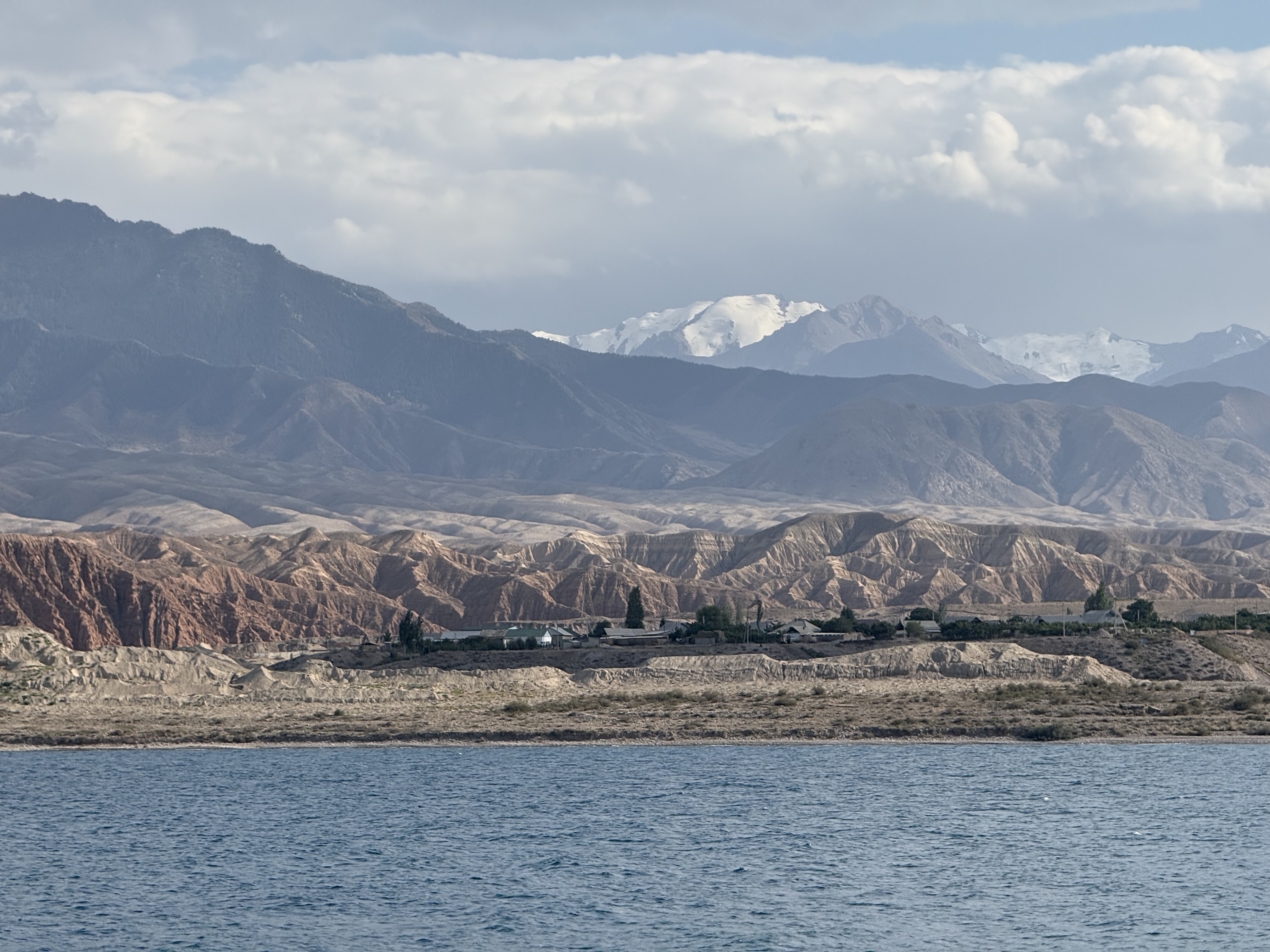
Kyrgyzstan is one of the easiest places in Central Asia to actually get to, and one of the hardest to stop thinking about afterwards. Roughly 90% of the country sits inside the Tien Shan and Pamir-Alay ranges, and for a lot of that mountainous 90%, nomadic life hasn't gone anywhere. Families still spend summers in yurts up on the high pastures, horseback games are still a normal Sunday activity rather than a show put on for tourists, and Issyk-Kul, the second largest alpine lake on Earth, sits almost entirely surrounded by empty mountains rather than resorts.
Kyrgyzstan is landlocked in the heart of Central Asia: Kazakhstan to the north, Uzbekistan to the west, Tajikistan to the southwest, and a long mountainous border with China's Xinjiang region to the east. Bishkek, the capital, sits in the north near the Kazakh border, and most trips either loop out from there or continue south towards Osh.
This guide pulls together everything you need before you go — visas, getting in, money, health, safety, food, the sites worth building a trip around, languages, and when to visit. Where we've written a full standalone guide on a topic, we've linked to it, so use this as your starting point and dig into the specifics from there.
Why Visit Kyrgyzstan?
In a nutshell, Kyrgyzstan is the most accessible nomadic culture left in Central Asia, paired with the easiest visa regime in the region and a mountain landscape that genuinely earns comparisons to Switzerland or Patagonia. It's also, right now, an unusually good time to go: the World Nomad Games, the biggest celebration of nomadic sport and culture anywhere in the world, returns to Bishkek and Issyk-Kul from 31 August to 6 September 2026, having been held elsewhere in between editions.
Kyrgyz identity runs through all of it. Kojomkul , the country's own real-life folk strongman, is still a household name, and events like kok-boru (a chaotic, full-contact game played on horseback with a goat carcass) sit at the centre of the Games rather than on the sidelines. We've written about some of the countries you might not expect to see competing: 10 Countries Competing in the World Nomad Games That Will Surprise You . Kyrgyzstan is also genuinely well set up for independent and small-group travel by regional standards, with a long-established network of community-based tourism homestays across the country, which is part of why it's become onew of the easiest entry points into Central Asia for a lot of first-time visitors.
How Do I Get a Visa for Kyrgyzstan?
Kyrgyzstan has the most relaxed visa policy in Central Asia. Citizens of the US, UK, EU, Canada, Australia, New Zealand, Japan, South Korea, and most Gulf states can enter visa-free for up to 60 days, a policy that's been in place since 2012. Citizens of CIS countries (Russia, Kazakhstan, Uzbekistan, Tajikistan and others) don't need a visa at all. If your nationality doesn't fall into either of those groups, Kyrgyzstan has run an e-Visa system since 2017, letting you apply online for a 30 or 60 day tourist, business, or group visa ahead of arrival. Whichever category you fall into, always double check current requirements for your specific passport before booking, since visa policy here has genuinely shifted several times over the last decade.
If you need a visa and are travelling with us to Kyrgyzstan, get in touch and we can help arrange your e-Visa for you.
How Do I Get Into Kyrgyzstan?
Almost everyone arrives through Manas International Airport (BSZ) just outside Bishkek, Kyrgyzstan's main hub, or Osh Airport (OSS) in the south. Manas only recently changed its own code, worth knowing if you're booking flights: it was FRU for decades, under the city's old Soviet name Frunze, until it officially switched to BSZ and the name "Manas" in August 2025 as part of a wider move away from Soviet-era naming. We've written the full story here: Bishkek Airport Officially Changes Airport Code . Around two dozen airlines fly into Manas, but very few routes are direct from Europe or North America — expect to connect through hubs like Istanbul, Dubai, Moscow, Almaty, or Tashkent. We've broken down the cheapest ways to actually get here in What Is the Cheapest Way to Fly to Central Asia? .
Overland, the busiest crossing is with Kazakhstan, just outside Bishkek, followed by a crossing with Uzbekistan near Osh. The crossings into China, at Irkeshtam and Torugart, are two of the most dramatic border crossings anywhere in the world, running over high mountain passes, but they need pre-arranged transport and permits on the Chinese side and can close without warning in bad weather. The Tajikistan border has had a more complicated recent history: after a series of clashes, a March 2025 bilateral agreement reopened cross-border movement, though the status of individual crossings can still change at short notice. We've covered both sides of that story: The Reopening of the Tajikistan-Kyrgyzstan Border and Update on the Kyrgyzstan - Tajikistan Border Clashes .
What's the Currency, and How Much Does It Cost?
The currency is the Kyrgyzstani som (KGS), trading at roughly 87 to 90 som to the US dollar through 2026. ATMs are widely available in Bishkek and Osh, dispensing local currency and generally accepting Visa and Mastercard, though foreign-card fees vary a lot between banks and it's worth avoiding the machines at the airport specifically, where fees tend to be highest. Once you're outside the two main cities, especially anywhere near a community-based tourism homestay or up in the mountains, cash is king and card acceptance drops close to zero, so plan ahead. Kyrgyzstan is inexpensive by regional standards, and even less so once you're eating and staying with local families on the homestay network rather than in hotels.
Money exchange places are everywhere in Kyrgyzstan, but best to do most of your changing in Bishkek so you don’t get stuck without cash in the countryside.
Health
Altitude is the major consideration when traveling in Kyrgyzstan with plenty of the country's best sites, Song-Kul among them, sit above 3,000 metres, so ascend gradually where you can, stay hydrated, and know the symptoms of altitude sickness before you head up into the mountains. As always, stick to bottled or properly filtered water. If you are planning on staying for several nights at 3000m or above you may want to look into altitude sickness tablets, but generally for one night you will be fine. Note that thinner oxygen at the higher altitudes will leave you out of breath faster than usual, and the views will be leaving you equally as breathless.
Is It Safe to Travel to Kyrgyzstan?
Yes, and by a wide margin compared to some of its neighbours. The current US State Department advisory rates Kyrgyzstan Level 1, "Exercise Normal Precautions," the same rating given to much of Western Europe, and violent crime against foreigners is rare. In our opinion travel to Kyrgyzstan is extremely safe and is a fantastic place to start any Central Asian adventure!
Food
Kyrgyz food reflects its nomadic roots more directly than almost anywhere else in the region. Here are five dishes worth seeking out:
Beshbarmak
Meaning "five fingers" for the traditional way of eating it by hand, beshbarmak is Kyrgyzstan's national dish: boiled mutton, beef, or horse meat laid over broad hand-cut noodles with an onion-rich broth. It carries real ceremonial weight, with specific cuts of meat distributed according to age and status at the table.
Plov
The rice, carrot, and meat pilaf found across Central Asia, plov is especially strong in the south around Osh, where it's often cooked in huge batches over an open flame for weddings and celebrations.
Manty
Large steamed dumplings, usually filled with minced mutton or beef, onion, and pumpkin in season. They show up on almost every menu and are a reliable, filling option if you're not sure what else to order.
Lagman
A hand-pulled noodle soup with Uyghur roots, served either brothy or stir-fried, with mutton or beef, peppers, and a good amount of garlic and chilli. A staple lunch dish across the country.
Kymyz
Fermented mare's milk and the country's signature drink, only available fresh in summer when herders take their horses up to pasture. It's an acquired taste, slightly fizzy and sour, but a serving of it is still one of the clearest signs of hospitality you can be offered on the road.
What Are the Main Sites to See in Kyrgyzstan?
Kyrgyzstan rewards travellers who get outside Bishkek. These five sites are worth building a trip around:
Issyk-Kul
The world's second largest alpine lake, 182km long, with petroglyph fields and ancient burial mounds on the quieter northern shore and resort towns strung along the south.
Song-Kul
A high-altitude summer pasture at just over 3,000 metres, only reachable from June to September. The standard way to see it is a night or two in a real working yurt camp rather than a tourist recreation of one.
Tash Rabat
A 15th-century stone caravanserai stranded in the mountains near the Chinese border, and one of the most atmospheric Silk Road sites left standing anywhere, especially if you camp nearby rather than passing straight through.
Osh and Sulaiman-Too
Osh, in the south, is one of the oldest continuously inhabited cities in Central Asia and home to Sulaiman-Too, a UNESCO-listed sacred mountain right in the middle of the city.
Ala-Archa National Park
An easy day trip from Bishkek into genuinely alpine terrain, with hiking trails ranging from a gentle afternoon walk to routes that push up towards glaciers and 4,000m peaks.
For something a little stranger, we've also written about The Chon-Kyzyl-Suu Meteorology Centre , a Soviet-era relic tucked away in the mountains, and for a wider overview of the country's regions, The 7 Regions of Kyrgyzstan is a good next stop.
Languages
Kyrgyz and Russian are both official languages. Kyrgyz is a Turkic language, closely related to Kazakh and Uzbek and more distantly to Turkish, and it's the language you'll hear most in rural areas and among younger generations. Russian remains the dominant urban language, especially in Bishkek and among older Kyrgyz, and is still widely used in business and government. English is limited outside guides, hotels, and tourism-facing staff in the main tourist areas, so a phrasebook or translation app is genuinely useful once you're off the well-trodden routes.
When Is the Best Time to Visit Kyrgyzstan?
May through September is the main travel season, with the high-altitude sites, Song-Kul in particular, only accessible from June to September once the passes clear of snow. September specifically tends to have the best combination of comfortable temperatures and thinner crowds. Winters are cold and snowy, and while that opens up decent skiing, it also closes many of the mountain roads that make the classic Kyrgyzstan route possible in the first place. This year is a particularly good one to time a trip around: the World Nomad Games return to Bishkek and Issyk-Kul from 31 August to 6 September 2026, and it's genuinely one of the more remarkable things you can watch anywhere in the world, from eagle hunting to horseback wrestling. We've written more on it here: 10 Countries Competing in the World Nomad Games That Will Surprise You .
Do We Offer Kyrgyzstan Tours?
Yes. Our Nomad Games Tour Kyrgyzstan and Nomad Games Mega Tour Kyrgyzstan are both built specifically around this year's Games in Bishkek and Issyk-Kul. Beyond that, Kyrgyzstan features heavily across our wider Central Asia itineraries, including the 4 Stans and 5 Stans tours running in spring, summer, and autumn, and the more ambitious 7 Stans Tour for travellers who want to see the whole region in one trip.
How Can I Book a Tour?
Get in touch at [email protected] and we'll help you find the right dates, talk through what a trip like this actually involves, and get you booked in.