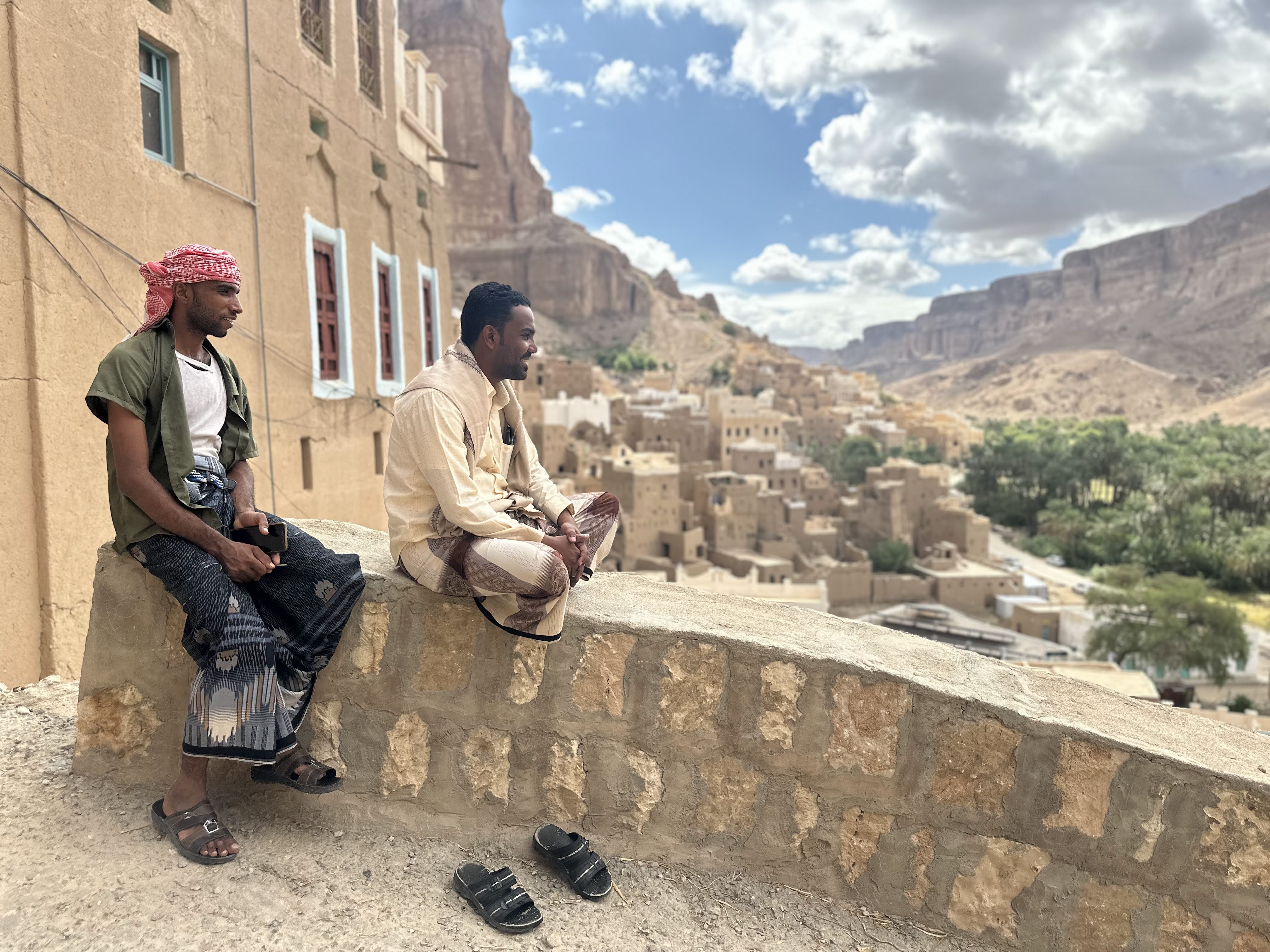
Yemen is the birthplace of the Arabic language and, by most accounts, of coffee itself — a country that built extraordinary civilisations long before oil turned its Gulf neighbours into skylines, and one that still holds mudbrick cities taller than anything comparable anywhere else on Earth. It's also, undeniably, a country in the middle of a long and difficult war, and we're upfront about that throughout this guide, including exactly which parts of Yemen our tours visit and which we deliberately avoid.
Yemen sits on the southwestern tip of the Arabian Peninsula, split today into three de facto zones — the Houthi-controlled north around the capital Sana'a, the internationally recognised government's territory in the east and south, and the island of Socotra — and which zone you're talking about changes the entire conversation about safety, access and what you can actually see.
That history runs deep. This is where the Queen of Sheba is traditionally said to have ruled from, and the ancient Marib Dam, built more than 2,500 years ago, once irrigated one of the wealthiest kingdoms in pre-Islamic Arabia. Old Sana'a's tower houses and Shibam's mudbrick skyscrapers in Hadhramaut both grew out of the same building tradition, centuries apart, which tells you something about how consistently impressive Yemeni architecture has been across its history — war or no war.
Before anything else, read our honest breakdown of what's actually safe to visit in Yemen in 2026 — it's the most important page on this list, and it explains exactly why our tours only run in Hadhramaut and Socotra, not the wider country.
How to Get a Visa for Yemen?
Yemen doesn't run anything close to a self-service e-Visa system, and a mainland tourist visa is only realistically available if you're travelling with a tour operator who arranges the permissions and security clearances on your behalf — these can't be obtained at the border, and turning up without them means being turned away. If you're travelling with us, we handle the whole process; your visa is issued at your point of entry once the approvals clear, and we'd budget around two weeks for that paperwork to come through before you fly or drive in. One quirk worth knowing early: your passport can't show any evidence of past travel to Israel, or the visa won't be granted.
It's also worth knowing that the mainland Hadhramaut visa and the Socotra visa are two entirely separate processes, so joining one doesn't cover the other — we've covered exactly how the Socotra side works in our guide to flying into Socotra and sorting visas .
Getting Into Yemen — Flights and Land Borders
There are two practical ways into the parts of Yemen we visit, and neither involves flying into Sana'a, which isn't an option for foreign travellers right now. Overland, the only working route is Al-Wadiah, a land crossing out past Sharurah in Saudi Arabia's Najran Province — since November 2025 it's been the sole approved crossing for passenger traffic (not just cargo) between the two countries, with the road on the Yemeni side running through Al-Abr to Seiyun. By air, Seiyun (Sayun) International Airport reopened to civilian traffic in January 2026, with Yemenia running around 7 flights a week from Cairo, Jeddah and Aden — some Cairo–Seiyun routings continue on to Socotra, which makes combining the two destinations straightforward. Crossing from Oman used to be an option too, through Sarfait or Shihan/Al Mazyunah, but Yemen stopped allowing foreign entry that way in March 2024 — both borders still work for exiting into Oman, just not for coming in. We've written a full guide to Yemen's land border crossings covering visa lead times, checkpoints, and the practical details of each route.
Money — Currency and Costs
The currency is the Yemeni rial, and the situation is genuinely unusual: since a split between the two central banks, Yemen effectively runs two separate currency zones. Older banknotes still circulate and hold their value comparatively well in the Houthi-controlled north, while newer notes issued by the internationally recognised government in the south and east have depreciated heavily and fluctuated wildly — the exchange rate you'll find quoted online varies enormously depending on the source and the date, so don't rely on a figure you read months ago and check a live rate close to your travel dates instead. In the areas we actually visit, cash is king: ATMs don't work with foreign cards and credit cards are essentially unusable, so bring new, crisp, undamaged USD notes with you and budget conservatively, since the exchange rate between government and Houthi-issued rials can differ by as much as 50%.
Health
There's no dedicated health blog for Yemen yet, so a general note for now: make sure routine vaccinations are up to date, and check current guidance on yellow fever and typhoid before you travel, particularly if you're connecting through a country with its own entry requirements. Malaria risk exists in parts of Yemen but is low in the areas our tours actually cover; it's worth a quick conversation with a travel health clinic about whether prophylaxis makes sense for your specific itinerary. Bring any prescription medication with you from home, plus basics like pain relief and anything for stomach upsets — pharmacy supplies in Hadhramaut can be patchy, and this isn't a country to assume you'll be able to source something specific once you're there.
Safety
"Is Yemen safe" isn't really one question — it's three, because the country functions as three separate zones right now. Sana'a and the Houthi-controlled north are not somewhere we take travellers, full stop; government advisories telling you to avoid all of Yemen are accurate for this part of the country, and we've written more on exactly why Sana'a is completely off the table .
Hadhramaut, in the east, is a different story: it's stable enough for guided tours, and travelling with a local security escort who handles checkpoints and route planning is what turns a real risk into a manageable one. Socotra is safer again — barely touched by the mainland conflict, with flights now routed through Jeddah rather than Abu Dhabi. We've written a full breakdown of the safety picture across all three zones, and a dedicated piece on Socotra specifically, if you want the complete picture before booking.
It's worth saying plainly: government advisories that tell you to avoid all of Yemen are a floor, not the final word. They're written for an entire country from a desk thousands of miles away, and they don't make the regional distinction that actually matters on the ground. We've seen exactly the same pattern with our Mali and Afghanistan tours — a blanket advisory covering everywhere from the genuinely dangerous parts to the parts we run group tours through every year. Our job is knowing where the real risk sits, not pretending the advisory doesn't exist.
Food
Yemeni food regularly gets held up as some of the best in the Arabian Peninsula, which is exactly why dedicated Yemeni restaurants are common in Saudi Arabia and the UAE. Expect spicy, fragrant dishes built around huge sheets of tandoor-baked flatbread: saltah, a hearty stew topped with a frothed fenugreek foam, is considered the national dish, while mandi sees lamb or chicken slow-cooked over rice in a pit dug into the ground so the meat's smoke and juices drip straight into the rice below. For something sweeter, bint al-sahn is a layered, honey-soaked flatbread worth saving room for. Alcohol is illegal countrywide, but Yemen has its own social ritual instead: chewing qat (khat), a mildly stimulant leaf, is a genuine afternoon institution here — we've written more on what chewing khat actually involves if you're curious. For the full rundown, see our Top 10 Yemeni Foods to Try .
What Are the Main Sites to See in Yemen?
Hadhramaut's headline site is Shibam , nicknamed the "Manhattan of the Desert" for its cluster of mudbrick tower houses rising straight out of the rock — some of the oldest examples of vertical urban planning anywhere in the world, and reason enough on its own to make the trip. In nearby Tarim, the Al Muhdhar Mosque is the tallest mudbrick structure on the planet, its whitewashed minaret rising more than 50 metres above the Hadhramaut landscape, and it still functions as a working mosque and library today. Beyond the two headline sites, the wider region rewards slower exploration — Seiyun, the coloured buildings and canyon scenery of Wadi Dawan, and the smaller towns across Wadi Hadhramaut all feature on our itineraries, and we've put together a full list of our favourite spots in Hadhramaut . And then there's Socotra, geographically part of Yemen but a world apart: dragon's blood trees, endemic wildlife found nowhere else on Earth, and a coastline that's barely seen a tourist — we've covered Socotra's own highlights separately.
Languages
Modern Standard Arabic is the official language, spoken day to day in a distinct Yemeni dialect closest to Saudi and Omani Arabic. Away from the mainland dialect, southeastern Yemen also holds onto two of the last surviving pre-Arabic South Semitic languages: around 70,000 people still speak Mehri, and Socotri — spoken only on Socotra — has roughly 57,000 speakers. English is limited outside of guides and hospitality staff, so having a Saiga guide do the talking for you is genuinely useful here, not just a formality.
When Is the Best Time to Visit Yemen?
Hadhramaut sits in a hot desert climate for most of the year, so the more comfortable window for travel runs from around November through February, when daytime temperatures ease off from the brutal mainland summer highs — which is also why our own Real Yemen Tour departs in January. Socotra follows a slightly different rhythm: the island is affected by seasonal monsoon winds, and the safest, most reliable window for visiting sits in the cooler months between roughly November and March, which lines up with when our Socotra tour runs. Outside of these windows, expect either intense heat on the mainland or rougher sea and flight conditions around Socotra.
In practical terms, that means daytime highs in Hadhramaut easing from the low-to-mid 40s Celsius in summer down to a far more manageable high 20s to low 30s between November and February — still warm, but no longer the kind of heat that ruins a day of walking around Shibam or Tarim. Evenings can get genuinely cool at this time of year too, so it's worth packing a light layer even if the days are warm.
Do We Offer Yemen Tours?
Yes — The Real Yemen Tour , departing January 2027 from Sharurah into Hadhramaut, and the Socotra Winter Tour if the island is more your speed. Both are run the way this guide describes: local security escort, a guide who knows exactly where the lines are, and none of the guesswork of trying to arrange it independently.
How Can I Book a Tour?
Send us an email at [email protected] and we're happy to talk through exactly what the current trip involves, including the visa process, before you commit to anything.